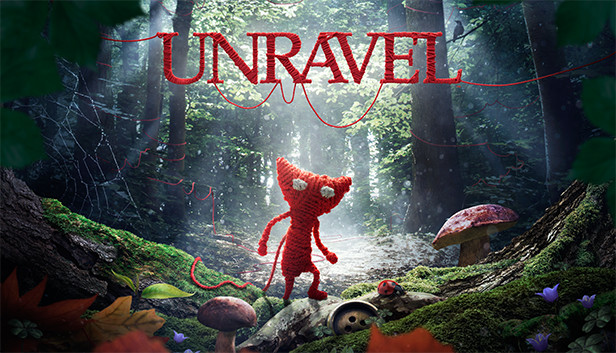
Unravel casts the player as Yarny, a small figure made from a single unspooling thread, sent out from an old woman's home to piece together fragments of her memories across the Swedish countryside. Coldwood Interactive built the entire game around that one physical conceit: Yarny's body is a literal length of yarn, trailing behind him as he climbs, swings, and stretches across streambeds, attics, and overgrown gardens, and the thread itself is both the character and the core traversal mechanic. Electronic Arts published it in 2016 under its Originals label, a small, personal project riding on a much bigger publisher's back.
What Works
The yarn mechanic is an inventive piece of physics-platformer design. Yarny can tie himself off to an anchor point and use the resulting thread as a rope, a sling, a tightrope, or a bridge, and the puzzles built around stretching that one resource across a level are consistently clever without ever needing a tutorial popup to explain the rules again. The environments carry an enormous amount of that design weight too: sunlit attics, rain-soaked gardens, and a gorgeous autumn forest sell a sense of scale and intimacy at the same time, small enough that a spool of thread is a believable protagonist, vast enough that the old woman's memories feel like they're worth piecing back together.
The whole thing is wordless, and it works because of that restraint rather than despite it. Every story beat comes through environmental details, photographs, furniture, the condition of a room, rather than dialogue or narration, and critics across the board singled out how much emotional weight the game manages to carry without a single line of spoken text. It's a short, focused idea, executed with real craft.
What Doesn't
The puzzle-platforming underneath the premise doesn't always match the ambition of the presentation. Later levels lean on precision jumps and tight timing windows more than the yarn-physics puzzles that make the game distinctive, and a handful of those sequences produce the kind of instant, unclear deaths that break the meditative pace the rest of the game works to build. GameSpot's own review captured the split directly, praising the atmosphere and story while flagging that the traversal itself isn't as sturdy as the character carrying it.
The length also works against it at full price: a roughly six-hour main story is enough to tell its story once and cleanly, but it leaves comparatively little reason to return, and reviewers at the time noted the asking price sat a little ahead of what the runtime alone would justify. Time and sales have mostly closed that gap.
A short, sincere idea that mostly lives up to its own reach. Unravel tells an entire family story through a spool of thread and a handful of Swedish landscapes, and the yarn-physics puzzles built around that idea are worth the trip on their own. The precision-platforming stretches near the end are the one place the game asks more of its mechanics than they're built to give.
Consulted for this review:
 Official art · via Steam